
What Is the Difference Between M.2 Sata and Nvme
What is the difference between M.2 SATA and NVMe? Learn how protocol, slot support, and enclosures affect compatibility in November 2026.
 By Elena Vasquez
Updated November 12, 2026

A drive can fit an M.2 slot physically and still use a protocol the slot or adapter doesn’t support. What is the difference between M.2 SATA and NVMe comes down to how the drive communicates: M.2 describes a form factor, SATA and NVMe describe different storage protocols, and NVMe drives use PCIe. That distinction affects which motherboard connector, adapter, or enclosure can recognize a drive. It doesn’t mean every NVMe drive will be faster in every task, or that every M.2 device is NVMe.
For an upgrade, check the computer’s documentation for the supported interface, slot, and drive dimensions before buying. A supplied list includes an NVMe PCIe adapter, an NVMe drive, an NVMe-only USB enclosure, and an enclosure that accepts both NVMe and M.2 SATA drives, so those items illustrate why the labels matter but aren’t interchangeable products. The M.2 and NVMe distinction is useful background when checking a drive listing. Manufacturer claims describe supported features, not independent performance measurements or proof of compatibility with a particular computer.
| Award | Product | BNR Score About BNR ScoreThe BNR Score is our own rating from 0 to 10, based on performance, design and build, ease of use, and value. It reflects independent research and is never influenced by manufacturers, retailers, or affiliate commissions. Learn more › | |
|---|---|---|---|
| Best Overall |
SABRENT M.2 NVMe SSD to PCIe X16/X8/X4 Adapter
|
9.1/10 | Buy |
| Best Premium |
 Silicon Power 512GB NVMe M.2 PCIe Gen3x4 2280 SSD |
8.9/10 | Buy |
| Best Budget |
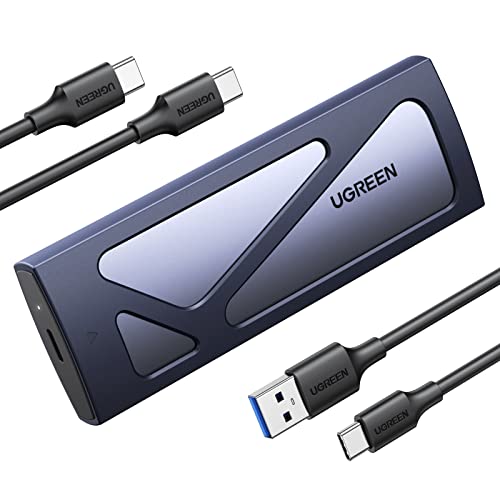 UGREEN USB-C M.2 NVMe SSD Enclosure, 10Gbps |
8.4/10 | Buy |
| Best Value |
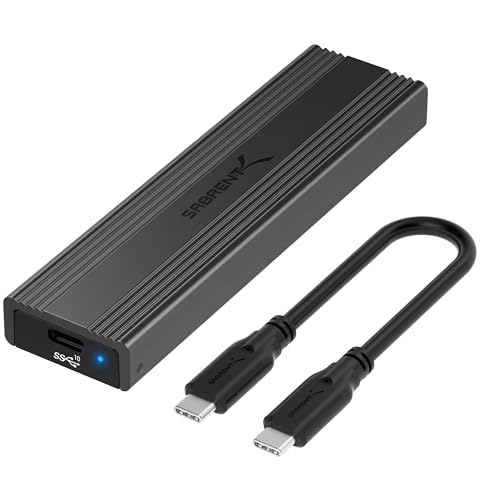 SABRENT Tool-Free NVMe & SATA M.2 SSD Enclosure |
8.3/10 | Buy |
How M.2 SATA and NVMe differ in practice
M.2 is a compact drive form factor, while SATA and NVMe identify different ways a storage device communicates with a host. SATA M.2 drives use the SATA interface; NVMe drives communicate over PCIe using the NVMe protocol. A connector’s shape or the fact that a drive is described as M.2 doesn’t, by itself, establish which protocol it uses.
| Term or item | What the supplied information establishes | What to verify |
|---|---|---|
| M.2 SATA | M.2 form factor with SATA interface; supported by the SABRENT dual-protocol enclosure description | Whether the host slot or enclosure supports SATA M.2 |
| NVMe M.2 | M.2 drive using NVMe; the Silicon Power listing specifies PCIe Gen 3×4 and 2280 | Whether the host supports NVMe, the listed PCIe connection, and the drive length |
| SABRENT PCIe adapter | Accepts NVMe M.2 drives; the listing excludes M.2 SATA and physical PCIe x1 slots | Drive protocol, supported physical slot, and BIOS NVMe support |
| USB enclosures | One supplied enclosure is NVMe-only; the other is described for NVMe and SATA M.2 | Protocol support, drive dimensions, host connection, and clearance |
These checks help distinguish a connector that looks right from a connection that works.
- Identify whether the existing drive is SATA M.2 or NVMe before selecting an enclosure.
- Check motherboard documentation for M.2 slot protocol support and available slot configuration.
- Match the drive length to the slot mounting positions listed by the system maker.
- Confirm a PCIe adapter’s physical slot requirement and whether BIOS NVMe support is documented.
- For an external enclosure, verify supported protocols, drive sizes, and the host cable and port.
Why the M.2 label doesn’t tell the whole story
M.2 identifies a physical format, not a guarantee of a particular protocol or speed. Products may use different keying and wiring, and host connectors can support one protocol, the other, or both. A drive that doesn’t match the slot’s supported interface may not be detected, even if its dimensions appear suitable.
Key shapes can offer a clue, but they aren’t a substitute for checking the device and system specifications. For example, the supplied Silicon Power listing says that its PCIe drive requires an M.2 connector with an M key and lacks a B notch. That is a product-specific description, not a rule that can establish compatibility for every M.2 drive or motherboard.
There is a related distinction between an M.2 SATA SSD and a 2.5-inch SATA SSD. Both may use the SATA interface, but their physical formats differ. Neither should be confused with mSATA, which is a separate form factor. A system’s drive bay, connector, and documentation determine what it can accept.
A useful way to read a listing is to separate three details: the physical form factor, the interface or protocol, and the supported dimensions. Then check those details against the host device. The M.2 SATA and NVMe compatibility comparison can help clarify which distinction to verify when a listing uses both terms.
What the supplied adapter and enclosures support
The product descriptions demonstrate why accessory protocol support matters. The SABRENT PCIe adapter is described for NVMe drives and explicitly excludes M.2 SATA; it also calls for a physical PCIe x16, x8, or x4 slot and BIOS support for reading or booting NVMe over PCIe. Its presence in a list doesn’t mean it converts a SATA drive into NVMe.
The two USB enclosures have different stated protocol coverage. The UGREEN enclosure is described as NVMe-compatible and as not supporting SATA NGFF or mSATA. The SABRENT enclosure description says it accepts both M.2 NVMe and M.2 SATA drives, but excludes drives with a pre-installed heatsink and does not accept 2.5-inch SATA or mSATA drives.
Those distinctions are useful when repurposing an old drive as external storage. An NVMe-only enclosure won’t become suitable for SATA M.2 just because the drive fits its case, and an enclosure that supports both protocols still needs the correct drive length. Check the exact model documentation because protocols, dimensions, and host requirements vary among accessories.
The supplied Silicon Power drive is listed as an NVMe M.2 PCIe Gen 3×4 2280 SSD, with manufacturer-listed sequential read speeds up to 2,200 MB/s and writes up to 1,600 MB/s. Those are listing specifications, not independently measured results, and the provided data doesn’t establish performance in a specific computer or workload. A performance claim for this one model shouldn’t be treated as a specification for all NVMe drives.
How to check a motherboard or laptop before upgrading
Start with the computer or motherboard manual rather than inferring support from a product photo. Look for the M.2 slot’s supported protocol, the allowed drive dimensions, and any notes about which connectors or slots share resources. A laptop may also have physical clearance limits or a slot configuration that differs from a desktop board; verify those details for the exact system.
If an NVMe drive will be installed on a PCIe adapter, check the adapter’s physical slot requirement and the motherboard’s documentation for NVMe support through that route. The supplied adapter listing warns that older boards may not read or boot an NVMe drive through the card if BIOS support is absent. Physical insertion alone doesn’t prove that the system can detect or boot from it.
For an external setup, check the enclosure’s protocol and the computer’s USB port and cable requirements. The UGREEN listing says its stated 10 Gbps transfer rate requires a matching USB-C 3.2 Gen 2 data cable, and it identifies backward compatibility with earlier USB versions. The SABRENT enclosure also lists a 10 Gbps USB connection and notes that earlier USB versions operate at their own speed limits.
Use this short sequence to catch the most common specification mismatches before ordering.
- Find the exact computer or motherboard model and consult its current storage documentation.
- Check whether the M.2 connector supports SATA, NVMe, or both protocols.
- Match the drive’s stated length and key requirements to the documented slot.
- For a PCIe card, confirm both the physical slot and BIOS NVMe support details.
- For an enclosure, match its protocol support and drive clearance to the SSD.
- Check the host port and specified cable before interpreting an enclosure’s transfer-rate claim.
Speed claims, workloads, and benchmark limits
NVMe can support higher data-transfer performance than SATA, but protocol labels alone don’t predict a particular task’s result. The drive, host interface, workload, file size, queue behavior, and test conditions all affect observed performance. A manufacturer’s sequential maximum is a stated specification, not a guarantee of sustained transfer speed or a measure of every application.
Sequential transfers describe access to data arranged in larger, continuous operations, while random workloads involve smaller accesses across locations. Large file work may make sequential performance more relevant; everyday tasks and game activity can involve other system components and access patterns. Without matched independent benchmarks for the same capacities, platform, workload, and thermal conditions, a numerical comparison between unrelated claims would be misleading.
External enclosures add another limit: the connection between the enclosure and computer can constrain throughput. The UGREEN description gives a USB interface claim, while the SABRENT description also gives a USB transfer claim. Neither figure alone establishes the speed a specific SSD will reach through a particular cable, port, computer, or workload.
For gaming, office work, and general use, consider the whole system and the tasks that actually create storage demand. For repeated large transfers or storage-heavy creative workflows, sustained behavior and heat may matter more, but the supplied data doesn’t provide comparable sustained benchmarks or temperatures. Avoid treating a peak sequential figure as proof that one drive will make every task noticeably faster.
Capacity, heat, and ownership details
Capacity affects how much data fits, while protocol describes how the drive communicates. A larger drive isn’t inherently NVMe, and choosing NVMe doesn’t by itself determine how much storage a workload needs. Estimate the space required for the operating system, applications, games, media, and working files, then leave room for future use rather than selecting by interface name alone.
Heat and physical clearance also depend on the actual drive and installation. The PCIe adapter listing includes an aluminum heatsink, but that doesn’t establish that a heatsink is required for every NVMe drive. The dual-protocol enclosure description says it has no clearance for a drive with a pre-installed heatsink, so check the drive and enclosure combination rather than assuming all accessories fit together.
Endurance and warranty are separate from interface compatibility. The supplied Silicon Power listing gives a TBW figure of 150 and says warranty terms depend on whichever comes first, the warranty length or TBW limit, but it doesn’t supply the warranty duration here. Consult the current manufacturer’s warranty terms for coverage, exclusions, and any registration requirements; an endurance rating is not a prediction of an individual drive’s lifespan.
Software and operating-system support should be checked for the particular product and purpose. The provided listings mention operating-system compatibility for the adapter or enclosures, but they don’t supply a general firmware-tool comparison or prove support for every system version. Treat compatibility statements as product-description claims and confirm current documentation for the exact hardware combination.
Choosing the relevant distinction for your setup
A SATA M.2 drive can make sense where a system specifically supports that interface, while an NVMe drive is appropriate only when the host supports NVMe through the intended slot or adapter. For an external enclosure, protocol support is a direct compatibility requirement, not a speed preference. If documentation is unclear, ask the computer or motherboard manufacturer before relying on connector appearance.
Don’t pay extra for a headline speed without checking whether the host can use the drive’s interface and whether the workload benefits from it. Conversely, don’t assume a SATA M.2 drive will work in an NVMe-only adapter or enclosure. A dual-protocol accessory may offer broader drive support, but its dimensions, clearance, and host connection still set limits.
For an installation, follow the computer, motherboard, and drive manufacturers’ instructions. Power down and disconnect equipment as directed, observe electrostatic-discharge precautions, and don’t force a drive, connector, or heatsink into place. System-specific installation steps should come from the relevant manufacturer documentation rather than a generic assumption.
The practical answer is that M.2 is the format, while SATA and NVMe are different interfaces or protocols. Verify the protocol supported by the slot or accessory, then confirm dimensions, host support, and any clearance requirements against the exact product documentation.
About the author
Elena Vasquez covers console and laptop storage, including PS5-compatible NVMe drives, external enclosures, and adapters. She focuses on compatibility requirements and practical setup advice for readers expanding storage on devices with specific limits.