
What Is the Difference Between M.2 and Nvme: Form Factor and Protocol
M.2 describes a drive’s shape and connector, while NVMe is a storage protocol. Learn how the distinction affects compatibility in November 2026.
 By Marcus Hale
Updated November 12, 2026

A drive can fit an M.2 slot and still use the wrong protocol, so check both the connector and the motherboard’s supported storage interface. M.2 is a form factor, while NVMe is a protocol that lets compatible storage communicate over PCIe. The terms describe different things, even though product names often place them side by side. A motherboard or laptop must support the drive’s specific interface, keying, and physical size for it to work as intended.
The distinction matters when you’re upgrading a laptop, adding desktop storage, or choosing an adapter or external enclosure. An M.2 drive may use NVMe or SATA, and those interfaces are not interchangeable just because the drive has the same general shape. The products listed below include NVMe drives and adapters or enclosures, but their descriptions don’t establish compatibility with every computer. For a closer look at the naming distinction, see this M.2 and NVMe explanation.
| Award | Product | BNR Score About BNR ScoreThe BNR Score is our own rating from 0 to 10, based on performance, design and build, ease of use, and value. It reflects independent research and is never influenced by manufacturers, retailers, or affiliate commissions. Learn more › | |
|---|---|---|---|
| Best Overall |
SABRENT M.2 NVMe SSD to PCIe X16/X8/X4 Adapter
|
9.1/10 | Buy |
| Best Premium |
 Silicon Power 512GB NVMe M.2 PCIe Gen3x4 2280 SSD |
8.9/10 | Buy |
 Kingston NV3 1TB M.2 2280 NVMe SSD |
8.8/10 | Buy | |
| Best Value |
 SABRENT USB-C NVMe Enclosure & Reader |
8.6/10 | Buy |
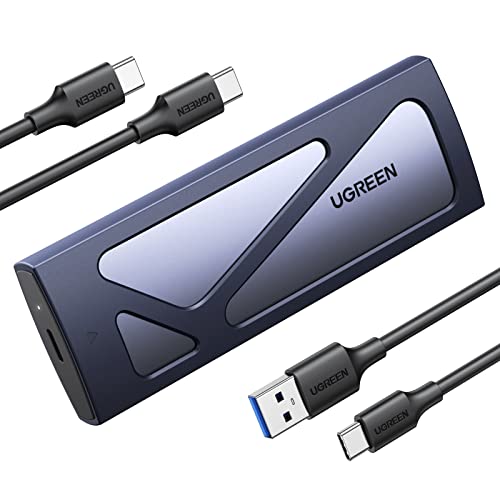 UGREEN USB-C M.2 NVMe SSD Enclosure, 10Gbps |
8.4/10 | Buy | |
| Best Budget |
 ECKDZMY SK1 M.2 NVMe SSD to PCIe 4.0 Expansion |
8.0/10 | Buy |
M.2 Describes the Drive, NVMe Describes How It Communicates
M.2 and NVMe are not competing formats. M.2 is a physical specification for compact internal components and connectors. NVMe is a protocol for accessing solid-state storage, generally over PCIe. A drive can therefore be M.2 in form and NVMe in protocol, but the M.2 label alone doesn’t tell you which protocol it uses.
| Term | What it describes | What to verify |
|---|---|---|
| M.2 | Drive form factor and connector family | Supported size, keying, and physical clearance |
| NVMe | Storage protocol commonly carried over PCIe | System support for NVMe and the relevant PCIe connection |
| SATA | Storage interface that may also be used by an M.2 drive | Whether the slot supports M.2 SATA, NVMe, or both |
These distinctions help narrow down what to inspect before ordering a replacement drive or adapter.
- Read the computer or motherboard manual for supported M.2 protocols.
- Check the drive listing for both M.2 and NVMe or SATA details.
- Match the drive’s physical length to a supported mounting position.
- Check connector keying, but don’t use notches as the only compatibility test.
- Confirm whether a populated M.2 slot disables or shares another connection.
What the M.2 label tells you, and what it leaves out
M.2 identifies a compact module and its connector system, not a guarantee of a particular transfer protocol. The label also doesn’t by itself establish the drive’s capacity, supported PCIe generation, performance, or suitability for a specific laptop. Those details must come from the drive’s specifications and the system documentation.
M.2 modules are identified by dimensions such as 2280, where the first two digits indicate a nominal width and the last two indicate length in millimeters. A system may have room for only certain lengths, or may require a separate mounting point for each supported length. Check the computer’s documentation or existing drive before assuming that a physically similar module will fit.
Connector keys are another clue, but they don’t provide a complete answer. M.2 connectors have different notch arrangements, and drives may use different keying depending on their design. A key that appears to match doesn’t prove that the motherboard supports the drive’s protocol, so verify the supported interface in the manual.
What NVMe means for the connection
NVMe is a protocol designed for non-volatile storage devices. In common M.2 SSD configurations, it communicates through PCIe lanes, but the actual connection depends on the SSD and system. A drive advertised for one PCIe generation or lane configuration may operate according to the capabilities supported by both sides of the connection.
That relationship is why an NVMe label alone doesn’t provide a complete speed prediction. The motherboard, slot, drive, firmware, and workload can all affect what the system supports or what a user experiences. Manufacturer maximum sequential read or write figures are specification claims, not a promise that every task will reach those rates.
Everyday tasks also differ from large sequential transfers. Starting an application, loading many small files, copying a large video, and running a sustained write workload do not stress storage in the same way. A peak sequential figure cannot establish how much faster a computer will feel for every use, and it should not be treated as a direct substitute for workload-specific measurements.
How M.2 SATA differs from M.2 NVMe
An M.2 SATA SSD uses the SATA storage interface even though it has an M.2 module shape. An M.2 NVMe SSD uses NVMe over PCIe in a compatible configuration. The two types may look similar, but their electrical interface and protocol differ, so a slot that accepts one type may not support the other.
Some computers support both interfaces in an M.2 slot, while others support only one. Slot-sharing arrangements can also vary by motherboard, including whether using a particular slot affects other ports or expansion connections. The manual is the dependable place to check the supported drive types and any restrictions.
Listings can make this confusing by combining “M.2,” “PCIe,” and “NVMe” in a product name. Read the detailed specifications rather than relying on a photograph, a general compatibility statement, or a matching module length. A comparison of the interface terminology is also available in this M.2 SATA and NVMe guide.
Check the whole compatibility chain before buying
A successful upgrade depends on more than the drive and its connector. Confirm that the computer has the relevant slot, accepts the drive’s protocol, provides a mounting point for its size, and supports the intended use. A desktop adapter adds further requirements, such as an available PCIe slot and firmware support for recognizing or booting from the drive.
These checks are especially important when using an adapter card. One supplied adapter description specifies an M.2 NVMe drive, a physical PCIe x4, x8, or x16 slot, and motherboard BIOS support for NVMe; it explicitly excludes M.2 SATA and PCIe x1 slots. Another listed expansion card describes an x1 connection and notes that its bandwidth is limited by that connection, illustrating why the precise adapter design matters.
External enclosures have their own protocol limits. The supplied enclosure descriptions distinguish NVMe-compatible devices from SATA M.2 drives, while one description states that a USB connection and suitable cable are required for its advertised interface rate. Those claims apply to the named enclosure descriptions, not to every USB enclosure or host computer.
Use this checklist to verify that the parts and system match.
- Look up the exact computer or motherboard model in its manufacturer documentation.
- Confirm the M.2 slot supports the drive’s NVMe or SATA protocol.
- Match the module length to a listed mounting position and available clearance.
- Check whether a heatsink, cover, or nearby component affects physical clearance.
- For a PCIe adapter, verify slot dimensions, lane support, and BIOS recognition needs.
- For an enclosure, confirm its supported protocol, module sizes, and host connection.
Interpreting advertised speeds and capacity
Manufacturer speed figures provide a useful specification point when comparing drives, but they describe stated conditions and may not predict every workload. The supplied product data lists one PCIe Gen 3 x4 drive with maximum read and write claims, and a separate PCIe 4.0 x4 drive with its own maximum claims. Those figures should not be treated as a controlled head-to-head result because the information provided does not establish identical capacities, test platforms, firmware, benchmark software, or thermal conditions.
Capacity can also affect the practical decision independently of protocol. A larger drive may offer more room for games, media projects, or working files, but the product information here does not provide a like-for-like capacity comparison across all listed drives. Estimate the space your current files and expected projects need, and leave room for updates and ongoing work rather than selecting solely from a speed headline.
Advertised performance is not the only ownership specification worth reading. The supplied information includes a TBW figure and warranty wording for one drive, and a limited warranty term for another. These are distinct manufacturer terms; the provided data doesn’t establish that all products have the same warranty coverage, endurance rating, or conditions.
Thermals, heatsinks, and installation limits
Heat management depends on the drive, the system’s airflow, nearby components, and the workload. Some adapter or enclosure descriptions include a heatsink or thermal pad, but that does not mean every M.2 drive requires an additional heatsink. Check the computer’s design and the drive or enclosure manufacturer’s instructions, particularly when a motherboard already has a cover or thermal solution.
Physical clearance deserves attention in compact laptops and tightly arranged desktops. A drive, attached heatsink, or enclosure may not fit a space intended for a different configuration. Avoid assuming that a supplied accessory will fit every motherboard or laptop, and don’t force a drive or cover into place.
Installation should follow the computer, motherboard, adapter, and drive manufacturers’ instructions. Power down and disconnect equipment as directed, observe appropriate electrostatic-discharge and handling precautions, and use only the specified mounting method. If the documentation is unclear, consult the manufacturer rather than improvising a fit or installation step.
Use the distinction to choose the right kind of product
For an internal upgrade, begin with the host system’s supported M.2 interface and physical size, then compare drive capacity and manufacturer specifications. For a desktop without an available M.2 socket, an adapter may provide another route, but the adapter’s slot requirements and BIOS support still matter. For portable storage, an enclosure must support the drive’s protocol and the computer’s external connection.
The product names in the supplied list cover several different roles, so they should not be read as six interchangeable internal SSDs. The list includes internal drives as well as PCIe adapters and USB enclosures. A buyer should first identify whether the need is a bare internal drive, an expansion card, or an external case, then check the appropriate compatibility details for that category.
Don’t pay for a specification without checking that the system can use it. A newer interface or higher advertised peak rate may not help if the host lacks matching support, while a basic storage upgrade may not need a premium performance tier. Conversely, a storage-heavy workflow may justify comparing supported PCIe capabilities and relevant workload results, provided those results come from comparable conditions.
The practical distinction is straightforward: M.2 tells you about the physical module, and NVMe tells you about its protocol. Before ordering, verify the drive type, slot support, dimensions, and any adapter or enclosure requirements in the manufacturers’ documentation.
About the author
Marcus Hale is a storage and PC hardware writer covering NVMe SSDs, M.2 drives, and gaming PC upgrades. He focuses on turning spec sheets, controller and cache details, and published benchmark data into clear comparisons that help readers pick the right drive for their budget.