
is nvme or sata faster
NVMe can be faster than SATA because the interfaces use different data paths, but the actual result depends on the drive and system. Learn the distinction in November 2026.
 By Priya Nair
Updated November 12, 2026

A drive connected over NVMe can transfer data faster than a SATA drive when the computer, connection, and workload let it use that advantage. The answer to is nvme or sata faster depends on whether you mean the storage protocol inside a computer or an external enclosure connected through USB. NVMe uses PCIe, while SATA is a separate storage interface with its own bandwidth limits. A fast interface specification alone doesn’t establish how quickly a particular drive will handle everyday work.
That distinction matters when you’re upgrading a computer, moving files through an enclosure, or checking whether an M.2 drive will work in a slot. An NVMe drive in a USB enclosure may be constrained by the enclosure and USB connection, so its internal interface doesn’t determine the complete transfer path. A dual-protocol enclosure can accept different drive types, but it doesn’t turn a SATA drive into an NVMe drive. Our SATA and NVMe distinction guide explains the core terminology, while the system’s documentation can confirm supported drives and slots.
| Award | Product | BNR Score About BNR ScoreThe BNR Score is our own rating from 0 to 10, based on performance, design and build, ease of use, and value. It reflects independent research and is never influenced by manufacturers, retailers, or affiliate commissions. Learn more › | |
|---|---|---|---|
| Best Overall |
UTECHMIX M.2 NVMe & SATA to USB C Docking Station
|
8.9/10 | Buy |
| Best Premium |
 RIITOP M.2 to SATA Adapter [6-Port] |
8.9/10 | Buy |
| Best Budget |
 M.2 NVME SATA SSD Enclosure Adapter ,V VCOM USB |
8.6/10 | Buy |
| Best Value |
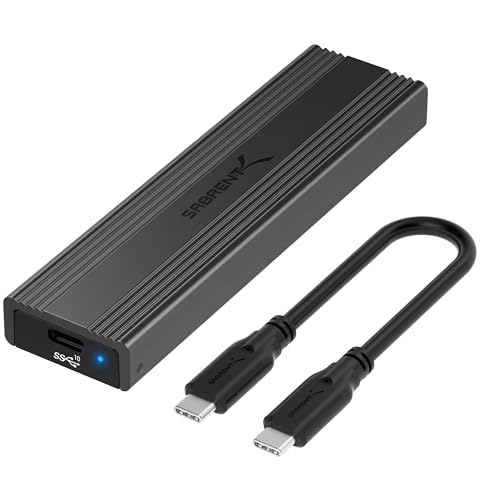 SABRENT Tool-Free NVMe & SATA M.2 SSD Enclosure |
8.3/10 | Buy |
Why NVMe and SATA speeds depend on the complete connection
NVMe is generally capable of higher transfer rates than SATA because NVMe communicates over PCIe, while SATA drives use the SATA interface. But the useful comparison isn’t simply the protocol names. A drive’s specification, the PCIe generation and lanes supported by the host, the workload, and any adapter or enclosure between the drive and computer can all affect the result.
| Connection described in supplied product information | Manufacturer or product listing claim | What the figure represents |
|---|---|---|
| External USB 3.2 Gen 2 enclosure or reader | Up to 10 Gbps | USB interface claim, not a guaranteed SSD transfer rate |
| SATA SSD protocol in a listed dual-protocol enclosure | Up to 6 Gbps | Protocol-specific claim in the product description |
| NVMe drive in an external USB enclosure | Up to 10 Gbps USB interface claim | External connection can limit the transfer path |
| Internal SATA compared with internal NVMe | No model-specific benchmark results supplied | Actual drive performance can’t be quantified from these details alone |
The figures in the table are claims from product descriptions, not independent measurements of the same SSD under matching conditions. Gigabits per second and gigabytes per second are different units, and a rated connection speed isn’t the same thing as the rate a file transfer will sustain. Protocol overhead, the host port, the drive, file sizes, and other system conditions can all reduce throughput.
These checks help separate an interface claim from a meaningful performance expectation.
- Check whether the drive itself uses SATA or NVMe, rather than relying only on an M.2 label.
- Confirm the computer’s slot supports the drive protocol and physical form factor.
- For external transfers, verify the enclosure and USB port specifications together.
- Compare results only when benchmark workloads and test conditions are comparable.
- Look for sustained and random workload results when those tasks matter to you.
Why M.2 alone doesn’t tell you which drive is faster
M.2 describes a physical drive form factor, not one universal data protocol. M.2 drives can use SATA or NVMe, and a connector that looks compatible doesn’t by itself establish that the motherboard supports both. The key check is the computer or motherboard documentation for the specific slot, including its supported protocol and any relevant limits.
Key notches can offer a clue, but they shouldn’t replace the manufacturer’s specifications. A slot may accept a drive physically yet lack support for that drive’s protocol, or it may share resources with another connection. For a desktop, also check which slots are available and whether installing a drive affects another port. For a laptop, consult its service and compatibility documentation before ordering.
For terminology beyond transfer speed, the M.2 SATA versus NVMe explanation helps clarify why the form factor and protocol should be checked separately. That distinction is especially useful when a listing says M.2 but doesn’t clearly identify whether its drive is SATA or PCIe NVMe. Don’t infer compatibility from a product photo or connector shape alone.
What changes in an external enclosure
An external enclosure adds another link in the data path: the SSD connects to an enclosure controller, which connects to the computer over USB. The slowest relevant part can limit the overall transfer, so an NVMe drive in a USB enclosure won’t necessarily deliver the internal performance associated with an NVMe connection. The computer’s port, cable, enclosure, SSD, and workload all matter.
The product information supplied for the listed enclosures describes USB connections up to 10 Gbps, and one description states a transfer claim of up to 1000 MB/s. Those are product claims for the external setup, not evidence that any included or installed drive reaches that rate in real use. No matched benchmark results, specific test files, host computer, or measurement method are supplied here, so the claims shouldn’t be treated as directly measured comparisons.
Dual-protocol support means an enclosure is described as accepting both compatible SATA and NVMe M.2 drives. It doesn’t mean the SATA drive gains NVMe performance, or that every M.2 drive fits every enclosure. Check supported keying and drive lengths in the enclosure documentation, then check the system’s USB ports and cable connection. A USB port with a lower capability can constrain transfers regardless of the drive inside.
For an external storage setup, these details are worth verifying before treating a speed claim as a likely result.
- Match the SSD protocol to the enclosure’s explicitly listed SATA or NVMe support.
- Check drive length and key type against the enclosure’s documented compatibility.
- Confirm the host USB port and cable support the intended connection.
- Account for the enclosure controller as part of the complete storage path.
- Read transfer figures as stated interface or manufacturer claims, not guaranteed outcomes.
Sequential speed, random access, and everyday tasks
Sequential throughput describes moving data in larger continuous transfers, such as copying a large video file. Random performance concerns smaller operations scattered across storage, which can be relevant to system activity and application workloads. A headline sequential figure alone doesn’t describe every task, and a product listing that provides no benchmark results can’t establish a measured advantage for a specific use.
For everyday browsing, office work, and many game loads, a faster interface may not translate into an equally obvious difference in every interaction. The result depends on the application and the rest of the computer, and no universal loading-time improvement can be inferred from protocol labels. Large file transfers or storage-heavy creative workflows may make throughput differences more relevant, but the complete system and sustained workload still determine what happens.
Benchmark comparisons need matched conditions to be useful. Check that the tested drives have comparable capacities, firmware, host hardware, interface generation, test software, file sizes, and queue settings. Temperatures and background activity can also affect results. A number from one test setup shouldn’t be presented as a direct comparison with a result measured using a different method.
Capacity, heat, and sustained transfers
Capacity and speed answer different questions. Capacity determines how much data the drive can hold, while the interface describes part of the route data takes. Buyers moving a large game library or media project may need more room before they need a higher peak transfer claim. Consider the current workload and expected file growth rather than assuming the fastest interface is automatically the most useful upgrade.
Sustained transfers can also differ from short bursts. A drive, its enclosure, and the host may behave differently during a brief copy than during a long transfer, but the supplied product descriptions don’t provide matched sustained-performance measurements. Don’t assume that an enclosure’s cooling description proves a particular temperature or transfer rate. Check product documentation and comparable independent measurements if prolonged workloads are central to the decision.
Heat management depends on the drive and the system arrangement. One enclosure description includes an aluminum shell and thermal pad, while another product listing describes an open-air design; those descriptions don’t establish actual operating temperatures. A laptop’s space and ventilation can differ from a desktop’s. Follow the computer, motherboard, and drive manufacturers’ instructions, and check clearance before installing a heatsink or enclosure.
Making a practical SATA or NVMe decision
Start with compatibility, then match the connection to the work. If the system supports NVMe and the workload involves frequent large transfers, an NVMe drive may be a sensible candidate, provided its specifications suit the slot and budget. If the system only supports SATA for the relevant connection, an NVMe drive isn’t an automatic upgrade path. A compatible SATA SSD can remain the practical option when it meets the workload and capacity needs.
The supplied product information covers adapters and enclosures, not benchmark-tested internal SATA and NVMe SSDs. It identifies some interface and form-factor claims, but doesn’t provide matched results, capacities for installed drives, endurance figures, or warranty terms. Those omissions mean the available information cannot establish a numeric performance gap, a reliability ranking, or which particular SSD is preferable for a given computer.
Before purchase, verify the exact drive model’s protocol, the host slot or port, and any enclosure limits in current manufacturer documentation. For installation or handling, follow the computer, motherboard, and drive manufacturers’ instructions, power down and disconnect equipment as directed, observe electrostatic-discharge precautions, and don’t force a drive or heatsink into place.
For a direct answer, NVMe is generally the faster-capable interface, but your actual result depends on the drive, system connection, and workload. Verify those details before treating a peak speed claim as the speed you’ll experience.
About the author
Priya Nair is a product editor who covers PCIe generations, motherboard M.2 compatibility, and storage upgrade guides. Her work emphasizes checking slot support, lane sharing, and form factors so readers know a drive will fit and perform in their system before they buy.