
Is Nvme Compatible With Sata: Protocol and Slot Compatibility
M.2 SATA and NVMe drives use different protocols, so a slot or adapter must support the drive type. See how to check in November 2026.
 By Marcus Hale
Updated November 12, 2026

A SATA connection does not make an NVMe drive compatible with a SATA-only M.2 slot; the host and adapter must support the drive’s protocol. The key distinction in is nvme compatible with sata is that SATA and NVMe are different storage protocols, even when both drives use the M.2 physical format. A connector that accepts the drive’s edge does not prove that its electronics or firmware can communicate with it. Checking the computer or adapter’s specifications before installation is the safest way to avoid a drive that is not recognized.
An M.2 SSD may use SATA or PCIe with NVMe, and those interfaces are not interchangeable by default. Some external readers are explicitly designed for both kinds, while other docks accept NVMe only; the product information must say which protocols are supported. The supplied product descriptions illustrate that distinction: one reader states support for both NVMe and SATA-based M.2 drives, while the SABRENT cloner is listed as NVMe-only. For a broader look at storage capacity decisions, see our 1TB NVMe SSD information.
| Award | Product | BNR Score About BNR ScoreThe BNR Score is our own rating from 0 to 10, based on performance, design and build, ease of use, and value. It reflects independent research and is never influenced by manufacturers, retailers, or affiliate commissions. Learn more › | |
|---|---|---|---|
| Best Overall |
SABRENT Dual-Bay USB-C 10Gbps M.2 NVMe SSD Cloner
|
9.2/10 | Buy |
| Best Value |
 RIITOP M.2 to SATA Adapter [6-Port] |
8.9/10 | Buy |
| Best Budget |
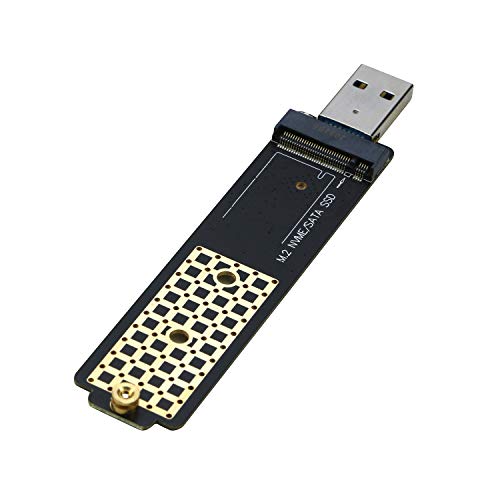 M.2 to USB Adapter, RIITOP NVMe to USB 3.1 Reader |
8.8/10 | Buy |
 AOKO NVMe to USB 3.2(10Gbps) |
7.8/10 | Buy |
Why SATA and NVMe Compatibility Depends on the Interface
NVMe is not compatible with a SATA-only connection by default. NVMe drives communicate over PCIe, whereas SATA drives use the SATA interface and protocol. Both types can be made in the M.2 form factor, so the shared shape can cause confusion, but physical format alone does not establish electrical or protocol support. A host slot, adapter, or enclosure must explicitly support the type of drive installed.
| Term | What it describes | Compatibility check |
|---|---|---|
| SATA | Storage interface and protocol used by SATA drives | Host or adapter must support SATA storage |
| NVMe | Storage protocol commonly carried over PCIe | Host or adapter must support NVMe over PCIe |
| M.2 | Physical form factor and connector family | Check dimensions, keying, and supported protocol |
| PCIe generation | Link generation supported by the host and drive | Confirm documented support; generation alone does not determine fit |
These checks help separate connector fit from actual drive support.
- Identify whether the drive is SATA-based M.2 or PCIe NVMe.
- Check the host manual for the slot’s supported storage protocol.
- Confirm the drive’s physical length and connector keying.
- Verify whether an adapter supports NVMe, SATA, or both.
- Check any stated PCIe generation and host limitations.
Why M.2 Shape and Keying Do Not Prove Protocol Support
M.2 describes a compact form factor, not a guarantee that every M.2 SSD uses the same signaling. A SATA M.2 drive and an NVMe M.2 drive may look similar, but they can require different host connections. Connector notches, often called keys, can help identify a drive, yet keying alone is not a complete compatibility check. Use the exact drive and computer documentation rather than relying on appearance.
A motherboard can have more than one M.2 slot with different capabilities. One slot may support NVMe, SATA, or both, while another may have narrower support or share resources with other connectors. Laptop designs also vary, and a slot’s physical presence does not establish that it accepts every M.2 storage type. The system manual or manufacturer specification is the authority for that particular machine.
What Happens When a Drive and Slot Use Different Protocols
A SATA-only M.2 slot generally cannot communicate with an NVMe drive simply because the drive fits. In the reverse situation, an NVMe-only host connection may not operate a SATA-based M.2 drive unless the slot also includes SATA support. Depending on the hardware, an unsupported combination may fail to appear in firmware or the operating system. Do not treat failure to detect a drive as proof that the drive itself is defective.
Adapters do not automatically convert one protocol into another. A passive adapter may change the physical connection while still depending on the host to support the drive’s native interface. Active devices can include controllers for a specific purpose, but their product documentation must clearly identify supported drive types and host connections. Check the exact adapter description, including any limits on simultaneous drives or intended use.
How to Check a Computer, Motherboard, or Reader
Start with the complete computer model or motherboard revision, then locate its storage specifications or manual. Look for explicit wording such as M.2 SATA, PCIe NVMe, or support for both; a generic reference to an M.2 slot is insufficient. Also check slot dimensions and any documented lane or connector-sharing conditions that could affect the configuration. For a USB reader, look for clear support for the exact protocol and drive size.
Before choosing a replacement or external reader, compare the details in this order.
- Record the drive model and its stated interface, protocol, and form factor.
- Find the host’s exact slot or port specification in its documentation.
- Match supported protocol, physical length, and connector keying.
- Check whether the adapter is NVMe-only, SATA-only, or dual-protocol.
- Review notes about shared ports, supported operating systems, or drive count.
- Confirm external USB connection limits without assuming advertised peak transfer rates.
The descriptions supplied for the available adapters show why these labels matter. The SABRENT Dual-Bay USB-C 10Gbps M.2 NVMe SSD Cloner is described as supporting NVMe drives and explicitly excluding M.2 SATA or AHCI drives. By contrast, the RIITOP M.2 to USB Adapter, RIITOP NVMe to USB 3.1 Reader and AOKO NVMe to USB 3.2(10Gbps) descriptions state support for both NVMe and SATA-based M.2 storage, with their own stated size or connection limits.
PCIe Generation and SATA Are Separate Compatibility Questions
PCIe generation concerns the link used by an NVMe drive, while SATA concerns a different interface. A PCIe Gen 4 NVMe drive may operate in a host that supports NVMe over a compatible PCIe connection, subject to the host’s documented capabilities, but it does not become a SATA drive. The negotiated link and resulting performance depend on both ends of the connection and the system configuration. A newer generation does not guarantee a noticeable improvement in every everyday task.
Sequential speed describes a particular type of transfer and does not predict every everyday task. Large file transfers may make sustained transfer behavior more relevant, while ordinary application use can depend on other factors, including workload and system configuration. External readers also add the limits of their bridge hardware and USB connection. Treat manufacturer-listed figures as specifications, not independent measurements of what a particular computer will achieve.
Using a Dual-Protocol USB Reader or Dock
A reader labeled for both NVMe and SATA can be useful when moving drives between systems, but confirm that the specific model supports the drive’s protocol, length, and keying. Some products support only one drive at a time, while others provide multiple bays; the supplied description should clarify the intended arrangement. USB-C describes the connector shape, not a guaranteed data rate, and the host port and cable can affect the connection. Check whether the device requires auxiliary power, especially if its description specifies it.
External access is not the same as internal motherboard compatibility. A dual-protocol reader may connect a SATA M.2 SSD to a computer over USB even if that computer’s internal M.2 slot is NVMe-only, because the reader supplies its own supported bridge path. That does not mean the SATA drive can be installed directly in the NVMe-only slot. Keep the distinction clear when choosing hardware for temporary file access, cloning, or routine external storage.
Installation, Migration, and Detection Checks
For an internal installation, follow the computer and drive manufacturers’ instructions. Power down and disconnect the system as specified by its manufacturer, handle components carefully, and avoid stressing the connector or drive. Do not force a module into a slot or assume a screw position proves support. If the drive is not detected, verify protocol support and seating using the documented procedure before changing firmware settings or formatting anything.
Operating-system migration adds a separate data-care concern. Confirm that the destination drive is supported, that the source and destination are identified correctly, and that the chosen migration method is intended for those drives. Keep a separate backup of important files before cloning or reinstalling, because a migration process can fail or affect the wrong storage device. An SSD is not a substitute for a backup, and no compatibility check can eliminate data-loss risk.
If a supported drive still does not appear, check the system documentation for firmware visibility, slot configuration, and resource-sharing notes. Avoid hot-swapping unless the specific hardware documentation explicitly supports it; one supplied adapter description states that hot swapping is not supported. Do not bypass protections or ignore temperature warnings. If the documentation leaves protocol support unclear, ask the computer or adapter manufacturer to confirm the exact model combination.
Making the Compatibility Decision Before Purchase
The decision is straightforward once protocol, form factor, and host support are checked independently. For a direct internal connection, choose a drive type explicitly supported by the documented slot, then confirm dimensions and any configuration conditions. For a USB enclosure or reader, select a device whose listed drive support matches the SSD rather than relying on the word M.2 alone. If both SATA and NVMe drives must be handled, require explicit dual-protocol support in the adapter documentation.
Capacity and performance matter after compatibility is established. Match capacity to the files and applications that need to remain on the drive, and consider sustained workload needs without assuming peak sequential specifications describe every task. For an external setup, the USB port and device capabilities also shape transfer behavior. The useful choice is the one that supports the required protocol and workload in the intended system, not simply the drive with the newest interface label.
So, an NVMe SSD does not work with a SATA-only M.2 slot by default. Verify the host or adapter’s explicit protocol support, then confirm physical fit and system constraints before installing or connecting the drive.
About the author
Marcus Hale is a storage and PC hardware writer covering NVMe SSDs, M.2 drives, and gaming PC upgrades. He focuses on turning spec sheets, controller and cache details, and published benchmark data into clear comparisons that help readers pick the right drive for their budget.