
What Is the Difference Between Nvme Ssd and Sata Ssd
NVMe uses PCIe, while SATA uses the SATA interface; the difference affects compatibility and potential transfer speed. Learn how to check your setup in November 2026.
 By Marcus Hale
Updated November 12, 2026

A drive must match your computer’s storage interface before its speed claims matter. The what is the difference between nvme ssd and sata ssd question comes down chiefly to how each drive communicates with the system: NVMe uses PCIe, while SATA SSDs use the SATA interface and command set. That distinction affects which motherboard slot or drive connector is needed, and it can affect potential transfer rates, but it doesn’t by itself predict how noticeable an upgrade will feel. A system’s supported interfaces, the specific drive, and the workload all matter.
Checking the labels can be confusing because M.2 describes a physical form factor, not a guarantee that a drive uses NVMe. M.2 SSDs can use either NVMe or SATA, so the drive and computer documentation need to agree on both interface and physical fit. The M.2 and NVMe distinction explains why those terms aren’t interchangeable. For a storage reader or enclosure, support for both types also doesn’t mean that the devices use the same protocol or reach the same transfer rate.
| Award | Product | BNR Score About BNR ScoreThe BNR Score is our own rating from 0 to 10, based on performance, design and build, ease of use, and value. It reflects independent research and is never influenced by manufacturers, retailers, or affiliate commissions. Learn more › | |
|---|---|---|---|
| Best Overall |
ACASIS 10Gbps M.2 NVMe & SATA SSD to USB Docking
|
9.2/10 | Buy |
| Best Budget |
 M.2 NVMe SATA SSD Enclosure Hard Drive |
8.6/10 | Buy |
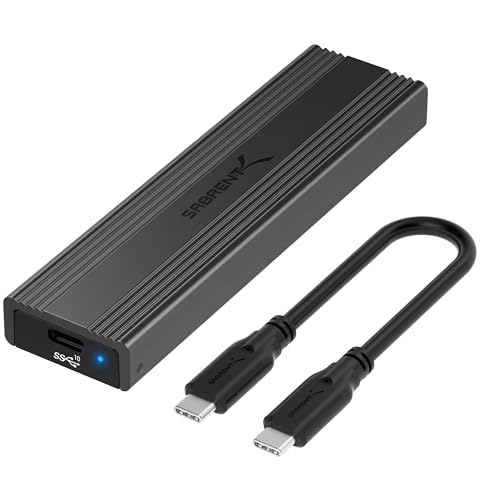 SABRENT Tool-Free NVMe & SATA M.2 SSD Enclosure |
8.3/10 | Buy |
How NVMe and SATA SSDs differ in practice
NVMe and SATA describe different ways for an SSD to communicate with a host. NVMe is a protocol designed for non-volatile storage over PCIe, while SATA SSDs communicate through the SATA interface and use the AHCI command set. That difference creates different potential bandwidth ceilings, but a particular drive’s real performance depends on its design, the connection, system support, and workload. A specification alone can’t establish the everyday result.
| Feature | NVMe SSD | SATA SSD |
|---|---|---|
| Communication | NVMe protocol over PCIe | SATA interface, typically using AHCI |
| Common physical formats | M.2 and add-in-card formats, depending on the drive | 2.5-inch and M.2 formats, depending on the drive |
| Compatibility check | Confirm supported PCIe/NVMe slot and physical fit | Confirm SATA port or M.2 SATA support and physical fit |
| Performance interpretation | Depends on drive, PCIe link, workload, and conditions | Bound by the SATA connection and drive characteristics |
These checks help distinguish interface requirements from performance assumptions.
- Check whether the drive is listed as NVMe or SATA, not just M.2.
- Confirm that the motherboard or laptop supports the drive’s interface.
- Verify the slot’s supported form factor and available physical clearance.
- Check whether the system shares lanes or disables another port when a slot is occupied.
- Compare manufacturer specifications only when capacities and test conditions are clear.
Why the interface changes potential speed
SATA was developed before NVMe and has a lower interface ceiling than PCIe-based storage. NVMe can use PCIe lanes to move data, with potential bandwidth depending on the PCIe generation and lane configuration supported by both the SSD and host. Those details are model-specific; the label “NVMe” alone doesn’t identify a drive’s PCIe generation or its maximum throughput. Consult the manufacturer’s specifications for the exact device and computer.
Published sequential read and write figures generally describe large, orderly data transfers under stated conditions. They can help identify a product’s capability, but aren’t a promise that every transfer will reach that rate. Random access, queue depth, file size, drive fullness, thermal conditions, and the host system can change results. If benchmark figures come from different test platforms or methods, treating them as a direct comparison can mislead.
Everyday tasks may not scale with peak sequential throughput. Opening small files, starting an application, or loading a game involves more than one large continuous transfer, so a higher advertised maximum doesn’t guarantee a clearly perceptible change. Large file copies and some storage-heavy workloads can make interface limits more relevant, but source-device speed and other system bottlenecks still matter. Look for independent results with disclosed methods when real-world performance is central to the decision.
M.2 shape does not identify the protocol
M.2 is a compact connector and card format used by SSDs with different interfaces. An M.2 SATA drive and an M.2 NVMe drive may look similar but aren’t automatically interchangeable in a given slot. Some systems support both types in a particular connector, while others support only one. The computer or motherboard manual and the drive’s specifications are the reliable places to confirm the combination.
Physical fit is another separate question. M.2 drives come in different lengths, and a system may have specific supported sizes or clearance constraints. A laptop may have limited room for a heatsink or a particular drive thickness, while a desktop motherboard may have a cover or heatsink arrangement that affects installation. Don’t assume that a slot’s shape confirms every form factor or feature is supported.
For a closer look at protocol distinctions, the NVMe and PCIe explanation can help clarify the terms: PCIe provides the connection, and NVMe is the storage protocol used over it. SATA is a different interface path. Keeping interface, protocol, and form factor separate makes compatibility checks easier and prevents a common shopping mistake: buying an M.2 drive based only on its appearance.
Choosing an interface for the actual workload
A SATA SSD can make sense when a computer supports SATA but lacks a compatible NVMe slot, or when the intended task doesn’t benefit enough from higher potential bandwidth to justify changing the system. An NVMe drive may be a sensible fit when the system supports it and the workload involves frequent, substantial storage transfers. Neither interface is automatically the right answer for every upgrade. Capacity, the existing drive, system support, and the intended use all shape the decision.
For gaming, check whether a specific game or platform has storage requirements and whether the computer supports the chosen drive. A faster interface doesn’t guarantee a matching improvement in game loading, because software, CPU activity, memory, and other factors contribute. For office work and everyday browsing, capacity and a compatible connection may matter more than peak sequential numbers. For video editing or large project files, sustained transfers and the full storage workflow deserve closer attention.
Creators should distinguish a brief benchmark burst from a longer copy or capture workload. Some drives can change speed after their fast cache is exhausted, and heat or available free space can also influence sustained behavior. These are model-specific characteristics, not automatic properties of every SATA or NVMe SSD. Seek applicable measurements that disclose drive capacity, test duration, workload, host platform, and thermal conditions rather than relying on interface names alone.
Capacity, benchmarks, and product claims
Capacity can influence product behavior and benchmark results, so comparisons should use the same or clearly identified capacities. A manufacturer’s top speed for one capacity shouldn’t be applied to an entire product family unless the documentation says the figures are shared. Also check whether a quoted result is sequential or random, read or write, and tied to a specific test setup. Without those details, the figure has limited value for predicting a buyer’s workload.
For endurance, look for the manufacturer’s stated rating and warranty terms for the exact model. Endurance figures describe a rated amount of writing under defined terms; they don’t predict the failure date of an individual SSD. Warranty coverage may include conditions or exclusions, and registration or proof-of-purchase requirements can vary. Don’t infer warranty length or endurance from the NVMe or SATA label.
Product descriptions for external readers and enclosures introduce a related distinction: their USB connection can limit transfers even when the installed SSD uses NVMe. The listed enclosure capabilities are not the same as the internal drive’s interface speed, and host USB support also matters. Supplied specifications for some listed adapters describe up to 10Gbps USB connections, while another lists different ceilings for NVMe and SATA drives. Those are stated product claims, not independent measurements, and they don’t establish a universal transfer rate.
One supplied enclosure description lists support for both M.2 NVMe and SATA drives, while another specifies supported M.2 lengths and excludes drives with pre-installed heatsinks. These details concern enclosure fit and use, not a direct speed comparison between internal SSDs. An adapter advertised for multiple drive types may still have limits on which devices can be connected or used at once. Read the exact product documentation before relying on a compatibility statement.
Practical compatibility and safe installation checks
Before purchasing, identify the system’s available storage connection and check its manual for supported protocols, form factors, capacities, and any shared-port restrictions. Then compare that information with the exact drive’s current manufacturer documentation. For a laptop, also verify length and heatsink clearance; for a desktop, check slot availability and motherboard heatsink arrangements. If documentation is unclear, the system manufacturer can clarify which storage types a specific configuration supports.
These additional checks help avoid confusing a product label with proof of system fit.
- Read the system manual for supported SATA and NVMe connections.
- Match the SSD’s length and interface to the documented slot requirements.
- Check for heatsink clearance and any included motherboard thermal cover.
- Review warranty, endurance, and software terms for the exact drive model.
- Use benchmark results only when their capacities, platforms, and workloads are comparable.
If installing a drive, follow the computer, motherboard, and drive manufacturers’ instructions. Power down and disconnect equipment as directed, observe appropriate electrostatic-discharge and handling precautions, and never force a drive or heatsink into place. A heatsink may be useful depending on the system and workload, but its need and fit depend on the particular setup. If installation or compatibility is uncertain, consult the relevant manufacturer documentation before proceeding.
What to prioritize when the options differ
When both interfaces are supported, start with the workload and capacity requirement rather than the headline speed. Check whether the software or work involves sustained, storage-heavy transfers, and whether independent data reflects those conditions. Consider the current system’s limits: an older or shared connection may prevent a drive from reaching its advertised potential. Spending for a higher interface ceiling has less value if the host or task cannot use it.
For a straightforward upgrade, the most useful result may be a compatible drive with enough space, not the highest peak number on a product page. If the machine has only SATA support, an NVMe drive won’t become compatible just because it fits a similar-looking connector. If NVMe is supported, confirm its PCIe generation and lane configuration rather than assuming every NVMe product offers the same performance. The system manual and exact drive documentation resolve those questions.
Keep price and availability in perspective because they change over time, and compare the total setup rather than interface labels alone. A drive requiring an enclosure, adapter, or separate heatsink may have different practical costs and fit considerations than a bare internal drive. Supplied product descriptions can help identify stated features, but they don’t provide a controlled, independent comparison of real-world speeds. Treat claims about cooling or transfer performance as manufacturer statements unless comparable measurements are available.
In short, NVMe uses PCIe and SATA SSDs use SATA, but the best match depends on documented system support and the work the drive will do. Confirm the exact interface, form factor, capacity, and clearance in the system and drive documentation before buying or installing.
About the author
Marcus Hale is a storage and PC hardware writer covering NVMe SSDs, M.2 drives, and gaming PC upgrades. He focuses on turning spec sheets, controller and cache details, and published benchmark data into clear comparisons that help readers pick the right drive for their budget.