
Is Nvme Better Than Ssd
NVMe can offer higher interface bandwidth than SATA SSDs, but fit and workload matter. Learn the difference with is nvme better than ssd in November 2026.
 By Elena Vasquez
Updated November 12, 2026
A drive can fit an M.2 slot and still use a different storage protocol, so check both before upgrading. is nvme better than ssd depends on what “SSD” means: NVMe is a protocol used by solid-state drives, while SATA SSDs are another type of SSD. NVMe drives can offer much higher interface bandwidth than SATA models, but that specification alone doesn’t establish a noticeable benefit in every task. Your motherboard or laptop must support the drive’s interface, and the workload determines whether the extra bandwidth is useful.
For gaming, everyday computing, and launching applications, both types of SSD can provide responsive storage, while large transfers and storage-heavy creative work may make bandwidth differences more relevant. The products listed here include PCIe 4.0 NVMe models with manufacturer-stated peak sequential speeds, but those figures aren’t independent benchmark results and don’t predict sustained performance in every system. Capacity, available slots, cooling, and warranty terms also affect the decision. If you’re comparing protocols, this SATA and NVMe explanation clarifies the central distinction, while the M.2 and NVMe guide explains why connector shape alone doesn’t identify the protocol.
| Award | Product | BNR Score About BNR ScoreThe BNR Score is our own rating from 0 to 10, based on performance, design and build, ease of use, and value. It reflects independent research and is never influenced by manufacturers, retailers, or affiliate commissions. Learn more › | |
|---|---|---|---|
| Best Overall |
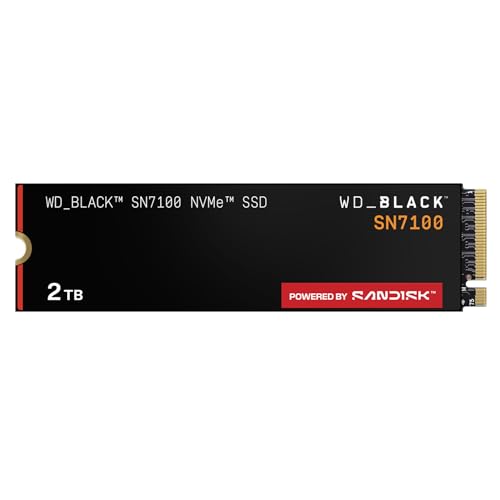
WD_Black SN7100 2TB NVMe SSD - Gen4 PCIe
|
9.2/10 | Buy |
| Best Budget |
 Kingston NV3 1TB M.2 2280 NVMe SSD |
8.8/10 | Buy |
 SANDISK Optimus 5100 500GB NVMe SSD, PCIe 4.0 |
8.4/10 | Buy | |
| Best Value |
 SANDISK Optimus 5100 1TB NVMe SSD, PCIe 4.0 |
8.4/10 | Buy |
| Best Premium |
 SANDISK Optimus 5100 2TB NVMe SSD, PCIe 4.0 |
8.1/10 | Buy |
NVMe versus other SSDs: what the difference means
NVMe is a storage protocol designed for solid-state storage and commonly connects through PCIe; SATA SSDs use the SATA interface. So the direct answer is conditional: an NVMe SSD may be a stronger fit when the system supports it and the workload benefits from its bandwidth, while a SATA SSD can remain suitable for general storage or a system without NVMe support. “SSD” describes the drive’s storage technology, not one particular interface or speed tier.
| Supplied NVMe option | Capacity | Documented interface and form factor | Manufacturer-stated peak sequential speeds |
|---|---|---|---|
| WD_Black SN7100 | 2TB | PCIe Gen4, M.2 2280 | Up to 7,250 MB/s read and 6,900 MB/s write |
| Kingston NV3 | 1TB | PCIe 4.0 Gen 4×4, M.2 2280 | Up to 6,000 MB/s read and 4,000 MB/s write |
| SANDISK Optimus 5100 | 500GB | PCIe 4.0, M.2 2280 | Up to 6,600 MB/s read and 5,600 MB/s write |
| SANDISK Optimus 5100 | 1TB | PCIe 4.0, M.2 2280 | Up to 7,100 MB/s read and 6,700 MB/s write |
| SANDISK Optimus 5100 | 2TB | PCIe 4.0, M.2 2280 | Up to 7,100 MB/s read and 6,700 MB/s write |
The table records product-description claims, not a controlled comparison. The products are not all the same capacity, and the supplied material doesn’t provide a common benchmark platform, workload, firmware version, or thermal condition. Peak sequential figures therefore help identify the stated performance tier, but they can’t establish a universal ranking or promise that one drive will feel faster in a particular PC.
These checks help separate interface facts from claims about everyday results:
- Confirm whether the system supports NVMe over PCIe or only SATA storage.
- Check the motherboard or laptop documentation for supported M.2 protocols.
- Match the drive’s physical size to the available slot and mounting point.
- Compare advertised read and write figures only when test conditions match.
- Consider capacity and workload alongside peak sequential transfer claims.
Why interface bandwidth doesn’t settle the comparison
Sequential speed describes transfers involving relatively continuous data, such as reading or writing a large file. Many ordinary computer tasks involve smaller or less predictable requests, so a peak sequential specification doesn’t summarize every part of storage performance. Random access behavior, queue depth, system configuration, software, and the type of files being handled can all affect measured results.
Even a published maximum is a manufacturer specification rather than evidence that a drive will sustain that rate throughout a long transfer. The supplied product information doesn’t include independently measured benchmarks or sustained-write results under shared conditions. Without those details, it’s more accurate to treat the numbers as stated ceilings for particular models than as a direct prediction of a user’s workflow.
For a gaming PC, storage may affect loading and installation tasks, but the supplied material doesn’t establish game-specific loading times or a measured advantage over SATA. A large sequential figure alone can’t show whether a particular title will load noticeably sooner. For an operating-system drive or common applications, responsiveness also depends on the rest of the system and the software being used.
Large media files, project assets, and repeated transfers can make storage bandwidth more relevant than routine browsing or document work. Even then, the source and destination drive, file sizes, transfer pattern, and thermal behavior can influence the result. A stated peak is useful context, but it isn’t a substitute for workload-matched measurements.
Compatibility: protocol, slot, and physical clearance
M.2 identifies a form factor and connector family, not a guarantee that a slot accepts every M.2 drive. Some systems provide M.2 slots for NVMe, SATA, or a specified subset of both; the exact support depends on the computer or motherboard. Verify the system manual and drive documentation rather than relying on the fact that both parts are labeled M.2.
The products in the table are listed as M.2 2280, and the supplied descriptions identify PCIe or PCIe Gen4 interfaces. That information can narrow the compatibility check, but it doesn’t confirm that a particular laptop or motherboard supports the interface, has an available slot, or accommodates a heatsink. Some laptops have restricted internal space, and installed covers or thermal components can affect physical clearance.
A PCIe generation mismatch also deserves a manual check. The system may specify which PCIe generation and lane configuration a slot supports, and that affects the connection available to the drive. Don’t assume that a generation label alone establishes the exact speed a system will deliver; consult the system manufacturer’s slot specifications and the drive maker’s current documentation.
Before buying, use this later checklist to verify the actual configuration:
- Find the exact slot’s supported protocol in the computer or motherboard manual.
- Check whether the M.2 position is available or shared with another connector.
- Verify the supported drive length and mounting location for the system.
- Review clearance around any motherboard cover or installed cooling hardware.
- Check manufacturer documentation for capacity and firmware requirements.
- Follow the computer, motherboard, and drive manufacturers’ installation instructions and handling precautions.
Capacity, workload, and the value of a faster specification
Capacity can be more important than a higher peak-speed claim if the drive will hold a growing game library, video projects, or large working files. The supplied options range from 500GB to 2TB, with several capacities represented by different products. Think about the space your files and applications need, including room for future growth, rather than treating the largest speed number as the only decision point.
A smaller drive may suit a secondary system or a focused set of applications, while a larger one may reduce the need to move files between drives. Those are planning considerations, not claims that one capacity is inherently right for every user. If the computer has limited storage slots, an additional capacity buffer may be useful; if it can take another drive, expansion may be an alternative.
The supplied feature descriptions mention creator applications, gaming devices, laptops, and handheld gaming devices as intended contexts for particular products. These are manufacturer descriptions, not evidence of measured application results or universal compatibility. Verify each device’s interface, physical requirements, and manufacturer support before treating a stated use case as confirmation that a drive fits.
Value depends on the difference in total system benefit, not simply the peak figures printed on product pages. If a computer is limited by an older interface, a faster-rated drive may not reach its advertised maximum. If ordinary tasks dominate, additional bandwidth may have little practical importance compared with having adequate space or keeping a suitable backup.
Warranty, endurance, and software details
The supplied Kingston NV3 description lists a five-year limited warranty and Acronis cloning software. A limited warranty is a manufacturer term, and the description provided here doesn’t include its complete conditions, exclusions, or registration requirements. Check the current warranty documentation for the specific region and product before treating the duration as the full scope of coverage.
The SANDISK Optimus 5100 listing states an endurance rating of up to 1,200 TBW for the 4TB model, which is not one of the listed capacities in the table. That figure must not be transferred to the 500GB, 1TB, or 2TB versions. The supplied product details don’t provide their individual endurance ratings, so a buyer who needs that comparison should consult the exact model’s current specification sheet.
TBW is a rated amount of data written under a manufacturer’s stated terms; it isn’t a prediction of when an individual drive will fail. Warranty duration and endurance rating answer different questions, and neither makes backups unnecessary. For important work, maintain a separate backup regardless of the SSD interface or stated endurance.
Software support can matter during migration or maintenance, but the provided claims have limits. The Kingston listing says Acronis cloning software is included, while the WD_BLACK product description identifies WD_BLACK Dashboard as Windows-only and the SANDISK listing mentions SANDISK Dashboard for monitoring and updates. Check current software requirements and the exact product’s support page before planning a cloning or firmware task.
Thermals and sustained workloads
Heat can affect storage behavior during demanding work, but no temperature measurements, throttling results, or included-heatsink details are supplied for these options. That means the available information can’t establish whether a particular drive needs additional cooling in a given computer. A heatsink may be useful depending on the system and workload, but it can also conflict with a laptop’s limited clearance or a motherboard’s supplied cover.
Short transfers and long sustained writes place different demands on a drive. A product’s maximum sequential write figure doesn’t show how quickly it writes a very large amount of data after any cache behavior changes, nor how performance responds to temperature. For frequent large transfers, look for independent measurements that disclose drive capacity, test size, platform, cooling, and the duration of the workload.
System-specific cooling guidance should come from the computer or motherboard documentation and the drive manufacturer. Don’t force a drive, cover, or heatsink into place. If installation is part of the upgrade, power down and disconnect equipment as directed by the manufacturer, observe electrostatic-discharge precautions, and follow the product’s handling instructions.
Making a practical choice between NVMe and SATA
NVMe is a reasonable direction when the system supports the protocol and the user wants a PCIe-connected SSD for an available M.2 slot. SATA can remain a sensible option for a system that supports SATA storage but not NVMe, or for a secondary storage role where its performance is adequate. The supplied product data describes NVMe drives only, so it doesn’t provide a controlled NVMe-versus-SATA benchmark or a like-for-like price comparison.
For gaming and general use, prioritize confirmed compatibility and enough capacity before paying extra for a higher maximum. For creative work with repeated large transfers, seek workload-specific sustained results instead of relying only on peak sequential claims. For laptops and handhelds, pay particular attention to the manufacturer’s interface support, internal space, and cooling arrangement.
The WD_Black SN7100 listing states up to 7,250 MB/s read and 6,900 MB/s write for the 2TB configuration, while the Kingston listing states up to 6,000 MB/s read and 4,000 MB/s write for its 1TB configuration. These are manufacturer-stated figures for different capacities and product models, not results from a shared test. The supplied data doesn’t support a conclusion about which one performs better in everyday use.
Likewise, the SANDISK 500GB configuration has lower listed peak figures than the 1TB and 2TB configurations, while endurance information supplied for the family refers to a 4TB version. Keep those capacity-specific distinctions intact when comparing specifications. Don’t assume a family-level feature applies identically to every capacity unless the manufacturer’s exact-model documentation confirms it.
Check the system manual first, then compare capacity, interface, and the workload evidence that matters to you. NVMe can offer substantially more interface bandwidth than SATA, but compatibility and actual use determine whether that difference is worth prioritizing.
About the author
Elena Vasquez covers console and laptop storage, including PS5-compatible NVMe drives, external enclosures, and adapters. She focuses on compatibility requirements and practical setup advice for readers expanding storage on devices with specific limits.