
Is Nvme Pcie or Sata
Is NVMe PCIe or SATA? Learn how NVMe, PCIe, and SATA relate, what an M.2 connector tells you, and which compatibility checks matter in November 2026.
 By Marcus Hale
Updated November 12, 2026

A drive’s M.2 shape alone doesn’t tell you whether it uses NVMe over PCIe or SATA, so check its interface before buying or installing it. The question is nvme pcie or sata mixes terms that describe different parts of storage: NVMe is a protocol, PCIe is a connection, and SATA is a separate interface and protocol family. An NVMe SSD typically communicates over PCIe, while an M.2 SATA SSD uses SATA signals despite sharing a general physical format. That distinction affects whether a drive works in a particular slot, adapter, or enclosure.
For example, the supplied product information distinguishes an NVMe-only PCIe adapter from an enclosure described as supporting both NVMe and SATA M.2 drives. That contrast is more useful than assuming every M.2 drive is interchangeable. Check the computer or motherboard documentation for supported interfaces, keying, slot behavior, and any boot requirements before making a purchase. Our M.2 and NVMe distinction explains why the connector’s shape and the drive’s protocol aren’t the same thing.
| Award | Product | BNR Score About BNR ScoreThe BNR Score is our own rating from 0 to 10, based on performance, design and build, ease of use, and value. It reflects independent research and is never influenced by manufacturers, retailers, or affiliate commissions. Learn more › | |
|---|---|---|---|
| Best Overall |
SABRENT M.2 NVMe SSD to PCIe X16/X8/X4 Adapter
|
9.1/10 | Buy |
| Best Value |
 Silicon Power 512GB NVMe M.2 PCIe Gen3x4 2280 SSD |
8.9/10 | Buy |
| Best Premium |
 SANDISK Optimus 5100 500GB NVMe SSD, PCIe 4.0 |
8.4/10 | Buy |
| Best Budget |
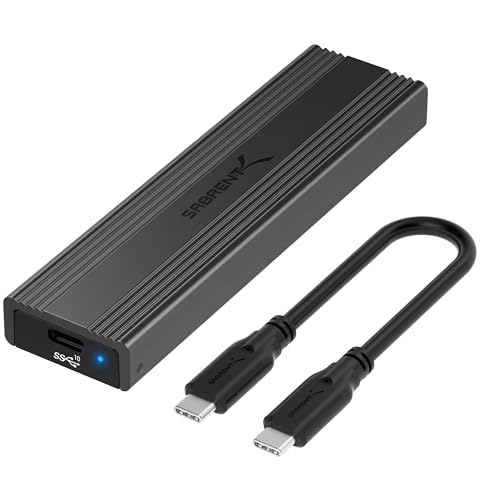 SABRENT Tool-Free NVMe & SATA M.2 SSD Enclosure |
8.3/10 | Buy |
NVMe uses PCIe, while SATA is a different drive interface
In common SSD specifications, NVMe drives use PCIe for communication with a host system, while SATA SSDs communicate through the SATA interface. M.2 describes a compact form factor and connector family, not one guaranteed protocol. As a result, an M.2 socket may support NVMe, SATA, or both, depending on the system. Confirm the exact support in the manufacturer’s documentation rather than relying on the drive’s size or appearance.
| Term or supplied item | What the supplied information establishes | Practical check |
|---|---|---|
| NVMe | Protocol identified for PCIe SSDs in the supplied product descriptions | Verify the host supports NVMe on the intended slot |
| PCIe | Connection used by the listed NVMe SSD and adapter | Check slot support, available lanes, and BIOS requirements |
| SATA | Separate interface supported by the listed dual-protocol enclosure | Verify SATA support if the drive is an M.2 SATA model |
| M.2 | Physical drive format; listed products support particular sizes | Check length, keying, slot fit, and heatsink clearance |
| Supplied enclosure | Lists NVMe and SATA M.2 support, USB Type-C, and up to 10Gbps | Remember the host connection can limit transfer rates |
These checks help distinguish the terms before a drive is ordered or moved between devices:
- NVMe describes a storage protocol, not the M.2 board’s physical dimensions.
- PCIe is the host connection used by the supplied NVMe drive and adapter.
- SATA is a separate interface, even when an SSD uses an M.2-shaped board.
- M.2 sockets differ in supported protocols, so consult the system manual.
- Connector keying can help identify fit, but it doesn’t replace compatibility checks.
Why the words don’t describe interchangeable options
Calling an SSD “M.2” identifies a physical format, while “NVMe” identifies how compatible storage communicates with the system. PCIe is the underlying connection for the NVMe models described in the supplied data. SATA M.2 drives use a different signaling path, although they can resemble NVMe drives in size. A familiar shape therefore doesn’t prove that a drive will function in every M.2 socket.
The distinction matters when an accessory supports only one protocol. The supplied SABRENT M.2 NVMe SSD to PCIe X16/X8/X4 Adapter description says it accepts M.2 NVMe drives and excludes M.2 SATA drives. Its description also specifies a physical PCIe x16, x8, or x4 slot, not an x1 slot, and says BIOS NVMe support is needed for the motherboard to see or boot from a drive. Those are product-specific conditions, not rules that establish compatibility for every adapter or computer.
A different accessory in the supplied data, the SABRENT Tool-Free NVMe & SATA M.2 SSD Enclosure, is described as accepting both M.2 NVMe and M.2 SATA drives in listed lengths. Its host connection is USB Type-C, so an installed drive connects externally through the enclosure rather than directly through the computer’s internal PCIe slot. The supplied description lists up to 10Gbps for the enclosure connection. That figure is a stated product limit, not a promise that every drive, cable, port, or file transfer will reach it.
What the listed examples can and cannot tell you
The product data includes an NVMe PCIe Gen3x4 M.2 2280 SSD with a stated read speed up to 2,200MB/s and write speed up to 1,600MB/s. It also includes a PCIe 4.0 M.2 2280 NVMe SSD whose supplied product title advertises read speeds up to 6,600MB/s and write speeds up to 5,600MB/s. Those are manufacturer-stated peak figures, not independently measured results, and they don’t establish what a particular computer will deliver.
Capacity-specific fine print also matters. The SANDISK product description separately says certain higher peak claims apply to specified capacities, while the supplied item is the 500GB model. Don’t transfer a specification listed for a different capacity to the exact drive being considered. Check the manufacturer’s current documentation for the exact model and capacity, and compare figures only when the test conditions and capacity match.
Advertised sequential transfer figures can help distinguish specifications, but they do not describe every task. Large sequential transfers, small random reads, operating-system activity, game loading, and sustained writes place different demands on storage. A headline number alone cannot establish whether a difference will be noticeable in a specific application. The host platform, available PCIe support, workload, drive capacity, and thermal conditions can all affect actual behavior, and the supplied product data doesn’t provide a common independent test across these items.
Compatibility checks for an internal PCIe installation
For an internal upgrade, verify the complete chain from drive to motherboard. Confirm that the slot supports the drive’s protocol and form factor, that the board has an available slot, and that the drive’s length and keying match the supported configuration. If using a PCIe adapter, also confirm the physical slot requirement, system BIOS support, and whether the computer can read or boot from NVMe storage through that arrangement. A drive fitting physically does not by itself prove that the system supports its protocol.
Use these checks to narrow down whether an internal NVMe setup is appropriate:
- Read the motherboard or computer manual for the exact M.2 slot protocol.
- Check whether the slot supports NVMe, SATA, or both before selecting a drive.
- Match the drive’s length and keying to the documented slot configuration.
- For an adapter, check its physical PCIe slot and motherboard BIOS requirements.
- Confirm heatsink clearance and follow the computer and drive manufacturers’ instructions.
- Check system documentation for boot support if the drive will hold the operating system.
Slot support can depend on the particular computer or motherboard, so don’t infer it from a general product family name. A manual may specify that using one slot affects another connection or that support varies by processor or board revision. If documentation is unclear, consult the manufacturer using the exact system model and configuration. This is more reliable than treating a matching connector or a seller’s broad compatibility statement as proof.
External enclosures change the connection path
An external enclosure can accommodate a drive through a USB connection, but the enclosure still needs to support the SSD’s protocol. The supplied dual-protocol enclosure is specifically described as supporting NVMe and SATA M.2 drives in sizes 2242, 2260, and 2280, while excluding drives with a pre-installed heatsink. Those stated restrictions make it unsuitable to assume that every M.2 drive will fit. Check the enclosure’s exact documentation against the drive’s protocol, dimensions, and cooling hardware.
USB transfer capability is another layer in the connection. The enclosure description lists USB 3.2 Type-C up to 10Gbps and says it is backward compatible with USB 3.1 and USB 3.0 at their respective speed limits. A compatible NVMe SSD inside such an enclosure does not communicate with the computer over the drive’s internal PCIe slot; the external link and the enclosure’s design shape the connection. Actual file-copy results may also depend on the host port, cable, drive, workload, and other conditions.
The enclosure description also says it supports Windows, macOS, and Linux versions within stated ranges, but operating-system support does not resolve every hardware or formatting question. Confirm the exact computer port, operating-system requirements, and drive format before relying on an external setup. For data transfer, consider whether the device’s existing file system is supported by the destination system. The product data doesn’t establish compatibility with every host device or every possible configuration.
Capacity, heat, and ownership details still need checking
Interface choice answers only part of a storage decision. A drive’s capacity should suit the files and applications it will hold, while its endurance rating and warranty terms should be checked for the exact model. The supplied data gives a TBW figure for the Silicon Power drive and notes that its warranty depends on whichever limit, warranty length or TBW, occurs first, but it doesn’t provide the warranty duration. The SANDISK description gives an endurance figure for a different, higher-capacity model, so that value should not be applied to the listed 500GB item.
Heat management also depends on the drive, enclosure, host, and workload. The NVMe-to-PCIe adapter description includes an aluminum heatsink and thermal pads, while the external enclosure description says there is no clearance for a pre-installed drive heatsink and includes a thermal pad. These details are useful when checking physical fit, but they don’t establish a measured operating temperature or prove that a heatsink is required in every system. Follow the applicable manufacturer instructions and don’t force a drive or cooling component into place.
For any installation or handling, follow the computer, motherboard, and drive manufacturers’ instructions. Power down and disconnect equipment as directed by those instructions, observe appropriate electrostatic-discharge precautions, and avoid forcing an SSD, adapter, screw, or heatsink. If installation requires a screw or a particular mounting method, check the system manufacturer’s guidance rather than improvising. The supplied Silicon Power description specifically advises checking with the motherboard or PC manufacturer if the needed screw is missing.
Match the drive and accessory to the intended connection
Start by identifying whether the existing drive or planned purchase is M.2 NVMe or M.2 SATA, then check the destination. An internal NVMe upgrade needs documented support for NVMe on the chosen slot; an adapter adds its own slot and BIOS conditions. A dual-protocol external enclosure may accept either protocol when the drive meets its stated size and physical restrictions. The terms answer different questions, so keep interface, protocol, physical format, and host connection separate.
If you’re comparing the terminology itself, our NVMe versus PCIe explanation clarifies how protocol and connection relate. Manufacturer speed claims can inform a comparison, but a system’s documented support and the workload remain important. For a particular computer, verify its manual and the exact drive and accessory documentation before ordering. If those documents don’t confirm support, treat compatibility as unresolved and ask the relevant manufacturer.
In short, NVMe SSDs use PCIe in the supplied examples, while SATA is a separate interface that some M.2 drives and accessories support. Check the drive protocol, host slot or USB connection, form factor, and manufacturer compatibility notes before committing to an installation.
About the author
Marcus Hale is a storage and PC hardware writer covering NVMe SSDs, M.2 drives, and gaming PC upgrades. He focuses on turning spec sheets, controller and cache details, and published benchmark data into clear comparisons that help readers pick the right drive for their budget.